|
||||||||||||
  |
|
Planet's plant life 'recycles' carbon dioxide faster than previously estimated
Wednesday, September 28, 2011
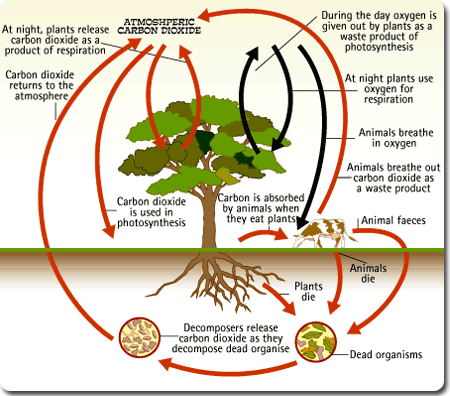
Novel Method for Measuring Global Photosynthesis Rate Scripps Institution of Oceanography / University of California, San Diego A Scripps Institution of Oceanography at UC San Diego-led research team followed the path of oxygen atoms on carbon dioxide molecules during photosynthesis to create a new way of measuring the efficiency of the world's plant life.A team led by postdoctoral researcher Lisa Welp considered the oxygen atoms contained in the carbon dioxide taken up by plants during photosynthesis. The ratio of two oxygen isotopes in carbon dioxide told researchers how long the CO2 had been in the atmosphere and how fast it had passed through plants. From this, they estimated that the global rate of photosynthesis is about 25 percent faster than thought. "It's really hard to measure rates of photosynthesis for forests, let alone the entire globe. For a single leaf it's not so hard, you just put it in an instrument chamber and measure the CO2 decreasing in the chamber air," said Welp. "But you can't do that for an entire forest. What we have done is to use a naturally occurring marker in atmospheric CO2 that let us track how often it ended up inside a plant leaf, and from that we estimated the mean global rate of photosynthesis over the last few decades."
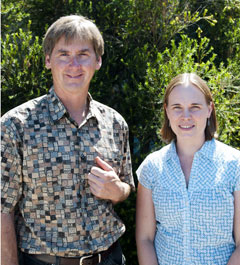
Report lead authors Ralph Keeling and Lisa Welp
Keeling added that part of the value of the study is its validation of the importance of long-term measurement series and of making multiple independent measurements of the same phenomena. The researchers conducted isotope analyses of air that has been collected by the Scripps CO2 group at several locations around the world since 1977. It was only after decades of measurements that the researchers saw that the several bumps in the isotope record matched the timing of El Niño events. They compared their data to samples collected by Australia's Commonwealth Science and Industrial Research Organization (CSIRO). The redundancy was needed to make sure the data from Scripps' own samples weren't the result of measurement errors, said Keeling, whose research group maintains the famous record of atmospheric carbon dioxide concentration known as the Keeling Curve. Keeling's father, Charles David Keeling, established the CO2 measurements in 1958. "Supporting long-term measurements is not easy through the normal funding mechanisms, which expect to see results on time scales of typically four years or less," said Keeling. "Few science agencies are happy to commit to measuring variables over longer periods but the value of tracking changes in the atmosphere doesn't stop after four years. Decades of measurements were required to unravel the features highlighted in this paper." Other co-authors of the report were Harro A.J. Meijer from the University of Groningen in the Netherlands; Roger Francey and Colin Allison from CSIRO; and Alane Bollenbacher, Stephen Piper, and Martin Wahlen from Scripps and Kei Yoshimura of University of Tokyo. The National Science Foundation and the federal Department of Energy have provided long-term support for collection of the data used in the study.
About Scripps Institution of Oceanography
|