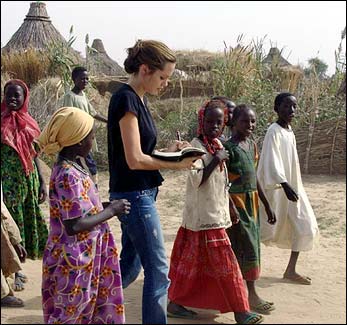
Sudan
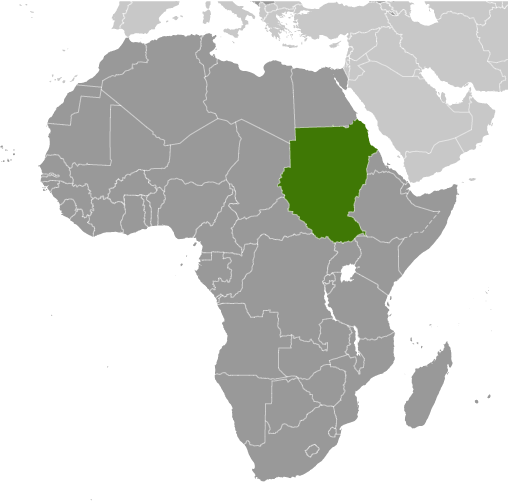
is the largest and one of the most geographically diverse countries in Africa.
Mountain ranges divide the deserts of the north from the swamps and rain forests
of the south, and the River Nile splits the country from east to west.
Military
regimes favoring Islamic-oriented governments have dominated national politics
since independence from the UK in 1956. Sudan was embroiled in two prolonged
civil wars during most of the remainder of the 20th century. These conflicts
were rooted in northern economic, political, and social domination of largely
non-Muslim, non-Arab southern Sudanese. The first civil war ended in 1972 but
broke out again in 1983. The second war and famine-related effects resulted in
more than four million people displaced and, according to rebel estimates, more
than two million deaths over a period of two decades.
Peace talks gained
momentum in 2002-04 with the signing of several accords. The final North/South
Comprehensive Peace Agreement (CPA), signed in January 2005, granted the
southern rebels autonomy for six years.
Nearly
99 percent of southern Sudanese voters have chosen to split off from northern
Sudan and form their own country According to the final count, announced in
Sudan’s capital, Khartoum, 98.83 percent of the more than 3.8 million
registered voters in southern Sudan chose to separate from the north. In many
parts of the country the vote was over 99 percent.
Southern
Sudan will not achieve formal independence until July 9, when the United
States-backed peace treaty that put the referendum in motion is set to expire.
By then southern Sudan hopes to pick a national anthem and a name; leading
contenders are Nile Republic and South Sudan.
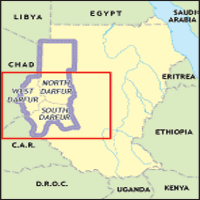
The Darfur conflictwas
an armed conflict in the Darfur region of western Sudan.
In 2003, militants accused the
government of President Omar al-Bashir of neglecting the region and oppressing
black Africans in favour of Arabs in the state of Darfur. Over half of the
people in the area are subsistence farmers, with the rest being nomadic or
semi-nomadic herders. The government, caught by surprise by the militants'
attacks, had very few troops in the region. In response, it mounted a campaign
of aerial bombardment in support of ground attacks by an Arab militia, the
Janjaweed, that it had recruited from local tribes. More than 2.5 million
people fled their homes since the fighting began.
The UN took command of the
Darfur peacekeeping operation from the African Union on 31 December 2007.
Sudan’s
entire civilian population faces enormous threats from continuing and
potentially new violence. The country’s future is at stake with an
upcoming referendum on southern independence (2011), as stipulated in the
Comprehensive Peace Agreement (CPA) that ended the civil war in 2005. With
continued disputes over borders and resources, in addition to the
challenges of creating new political systems in both the north and the
south, the prospect of separation is seeded with potential sources of
conflict
1881 - Revolt
against the Turco-Egyptian administration.
1899-1955
Sudan is under joint British-Egyptian rule.
1956 - Sudan
becomes independent.
1958 - General
Abboud leads military coup against the civilian government elected
earlier in the year
1962 - Civil
war begins in the south, led by the Anya Nya movement.
1964 - The
"October Revolution" overthrows Abbud and an Islamist-led
government is established
1969 - Jaafar
Numeiri leads the "May Revolution" military coup.
1971 -
Sudanese Communist Party leaders executed after short-lived coup
against Numeiry.
1972 - Under
the Addis Ababa peace agreement between the government and the Anya
Nya, the south becomes a self-governing region.
1978 - Oil
discovered in Bentiu in southern Sudan.
1983 - Civil
war breaks out again in the south involving government forces and
the Sudan People's Liberation Movement (SPLM), led by John Garang.
Islamic law
imposed
1983 -
President Numeiri declares the introduction of Sharia Islamic law.
1985 - After
widespread popular unrest Numayri is deposed by a group of officers
and a Transitional Military Council is set up to rule the country.
1986 -
Coalition government formed after general elections, with Sadiq al-Mahdi
as prime minister.
1988 -
Coalition partner the Democratic Unionist Party drafts cease-fire
agreement with the SPLM, but it is not implemented.
1989 -
National Salvation Revolution takes over in military coup.
1993 -
Revolution Command Council dissolved after Omar Bashir is appointed
president.
US strike
1995 -
Egyptian President Mubarak accuses Sudan of being involved in
attempt to assassinate him in Addis Ababa.
1998 - US
launches missile attack on a pharmaceutical plant in Khartoum,
alleging that it was making materials for chemical weapons.
1998 - New
constitution endorsed by over 96% of voters in referendum.
1999 -
President Bashir dissolves the National Assembly and declares a
state of emergency following a power struggle with parliamentary
speaker, Hassan al-Turabi.
Advent of oil
1999 - Sudan
begins to export oil.
2000 President
Bashir meets leaders of opposition National Democratic Alliance for
first time in Eritrea.
Main opposition
parties boycott presidential elections. Incumbent Bashir is
re-elected for further five years.
2001 Islamist
leader Al-Turabi's party, the Popular National Congress, signs
memorandum of understanding with the southern rebel SPLM's armed
wing, the Sudan People's Liberation Army (SPLA). Al-Turabi is
arrested the next day, with more arrests of PNC members in the
following months.
Government accepts
Libyan/Egyptian initiative to end the civil war after failure of
peace talks between President Bashir and SPLM leader John Garang in
Nairobi.
US extends unilateral
sanctions against Sudan for another year, citing its record on
terrorism and rights violations.
Peace deal
2002 -
Government and SPLA sign landmark ceasefire agreement providing for
six-month renewable ceasefire in central Nuba Mountains - a key
rebel stronghold.
Talks in Kenya lead
to a breakthrough agreement between the government and southern
rebels on ending the 19-year civil war. The Machakos Protocol
provides for the south to seek self-determination after six years.
2003 February
- Rebels in western region of Darfur rise up against government,
claiming the region is being neglected by Khartoum.
2003 October -
PNC leader Turabi released after nearly three years in detention and
ban on his party is lifted.
Uprising in west
2004 January -
Army moves to quell rebel uprising in western region of Darfur;
hundreds of thousands of refugees flee to neighbouring Chad.
2004 March -
UN official says pro-government Arab Janjaweed militias are carrying
out systematic killings of non-Arab villagers in Darfur.
Army officers and
opposition politicians, including Islamist leader Hassan al-Turabi,
are detained over an alleged coup plot.
2004 May -
Government and southern rebels agree on power-sharing protocols as
part of a peace deal to end their long-running conflict. The deal
follows earlier breakthroughs on the division of oil and non-oil
wealth.
2004 September
- UN says Sudan has not met targets for disarming pro-government
Darfur militias and must accept outside help to protect civilians.
US Secretary of State Colin Powell describes Darfur killings as
genocide.
Peace
agreement
2005
January - Government and southern rebels sign a peace deal.
The agreement includes a permanent ceasefire and accords on wealth
and power sharing.
UN report accuses the
government and militias of systematic abuses in Darfur, but stops
short of calling the violence genocide.
2005 March -
UN Security Council authorises sanctions against those who violate
ceasefire in Darfur. Council also votes to refer those accused of
war crimes in Darfur to International Criminal Court.
2005 June -
Government and exiled opposition grouping - National Democratic
Alliance (NDA) - sign reconciliation deal allowing NDA into
power-sharing administration.
President Bashir
frees Islamist leader Hassan al-Turabi, detained since March 2004
over alleged coup plot.
Southern autonomy
2005 9 July -
Former southern rebel leader John Garang is sworn in as first vice
president. A constitution which gives a large degree of autonomy to
the south is signed.
2005 1 August
- Vice president and former rebel leader John Garang is killed in a
plane crash. He is succeeded by Salva Kiir. Garang's death sparks
deadly clashes in the capital between southern Sudanese and northern
Arabs.
2005 September
- Power-sharing government is formed in Khartoum.
2005 October -
Autonomous government is formed in the south, in line with January
2005 peace deal. The administration is dominated by former rebels.
Darfur conflict
2006 May -
Khartoum government and the main rebel faction in Darfur, the Sudan
Liberation Movement, sign a peace accord. Two smaller rebel groups
reject the deal. Fighting continues.
2006 August -
Sudan rejects a UN resolution calling for a UN peacekeeping force in
Darfur, saying it would compromise sovereignty.
2006 October -
Jan Pronk, the UN's top official in Sudan, is expelled.
2006 November
- African Union extends mandate of its peacekeeping force in Darfur
for six months.
Hundreds are thought
to have died in the heaviest fighting between northern Sudanese
forces and their former southern rebel foes since they signed a
peace deal last year. Fighting is centred on the southern town of
Malakal.
2007 April -
Sudan says it will accept a partial UN troop deployment to reinforce
African Union peacekeepers in Darfur, but not a full 20,000-strong
force.
War crimes charges
2007 May -
International Criminal Court issues arrest warrants for a minister
and a Janjaweed militia leader suspected of Darfur war crimes.
US President George W
Bush announces fresh sanctions against Sudan.
2007 July - UN
Security Council approves a resolution authorising a 26,000-strong
force for Darfur. Sudan says it will co-operate with the United
Nations-African Union Mission in Darfur (Unamid).
2007 October -
SPLM temporarily suspends participation in national unity
government, accusing Khartoum of failing to honour the 2005 peace
deal.
2007 December
- SPLM resumes participation in national unity government.
2008 January -
UN takes over Darfur peace force.
Within days Sudan
apologises after its troops fire on a convoy of Unamid, the
UN-African Union hybrid mission.
Government planes
bomb rebel positions in West Darfur, turning some areas into no-go
zones for aid workers.
2008 February
- Commander of the UN-African Union peacekeepers in Darfur, Balla
Keita, says more troops needed urgently in west Darfur.
Abyei clashes
2008 March -
Russia says it's prepared to provide some of the helicopters
urgently needed by UN-African Union peacekeepers.
Tensions rise over
clashes between an Arab militia and SPLM in Abyei area on
north-south divide - a key sticking point in 2005 peace accord.
Presidents of Sudan
and Chad sign accord aimed at halting five years of hostilities
between their countries.
2008 April -
Counting begins in national census which is seen as a vital step
towards holding democratic elections after the landmark 2005
north-south peace deal.
UN humanitarian chief
John Holmes says 300,000 people may have died in the five-year
Darfur conflict.
2008 May -
Southern defence minister Dominic Dim Deng is killed in a plane
crash in the south.
Tension increases
between Sudan and Chad after Darfur rebel group mounts raid on
Omdurman, Khartoum's twin city across the Nile. Sudan accuses Chad
of involvement and breaks off diplomatic relations.
Intense fighting
breaks out between northern and southern forces in disputed oil-rich
town of Abyei.
2008 June -
President Bashir and southern leader Salva Kiir agree to seek
international arbitration to resolve dispute over Abyei.
Bashir accused
2008 July -
The International Criminal Court's top prosecutor calls for the
arrest of President Bashir for genocide, crimes against humanity and
war crimes in Darfur; the appeal is the first ever request to the
ICC for the arrest of a sitting head of state. Sudan rejects the
indictment.
2008 September
- Darfur rebels accuse government forces backed by militias of
launching air and ground attacks on two towns in the region.
2008 October -
Allegations that Ukrainian tanks hijacked off the coast of Somalia
were bound for southern Sudan spark fears of an arms race between
the North and former rebels in the South.
2008 November
- President Bashir announces an immediate ceasefire in Darfur, but
the region's two main rebel groups reject the move, saying they will
fight on until the government agrees to share power and wealth in
the region.
2008 December
- The Sudanese army says it has sent more troops to the sensitive
oil-rich South Kordofan state, claiming that a Darfur rebel group
plans to attack the area.
2009 January -
Sudanese Islamist leader Hassan al-Turabi is arrested after saying
President Bashir should hand himself in to The Hague to face war
crimes charges for the Darfur war.
2009 March -
The International Criminal Court in The Hague issues an arrest
warrant for President Bashir on charges of war crimes and crimes
against humanity in Darfur.
2009 May - An
estimated 250 people in central Sudan are killed during a week of
clashes between nomadic groups fighting over grazing land and cattle
in the semi-arid region of Southern Kordofan.
Alliance strained
2009 June -
Khartoum government denies it is supplying arms to ethnic groups in
the south to destabilise the region.
The leader of South
Sudan and vice-president of the country, Salva Kiir, warns his
forces are being re-organised to be ready for any return to war with
the north
Ex-foreign minister
Lam Akol splits from South's ruling SPLM to form new party, SPLM-Democratic
Change.
2009 July -
North and south Sudan say they accept ruling by arbitration court in
The Hague shrinking disputed Abyei region and placing the major
Heglig oil field in the north.
Woman journalist
tried and punished for breaching decency laws by wearing trousers.
She campaigns to change the law.
2009 August -
Darfur war is over, says UN military commander in the region, in
comments condemned by activists.
2009 October -
SPLM boycotts parliament over a Bill allowing intelligence services
to retain widespread powers.
2009 December
- Leaders of North and South say they have reached a deal on the
terms of a referendum on independence due in South by 2011.
2010 January -
President Omar Bashir says would accept referendum result, even if
South opted for independence.
2010 Feb-March
- The Justice and Equality Movement (Jem) main Darfur rebel movement
signs a peace accord with the government, prompting President Bashir
to declare the Darfur war over. But failure to agree specifics and
continuing clashes with smaller rebel groups endanger the deal.
2010 April -
President Bashir gains new term in first contested presidential
polls since 1986.
2010 July -
International Criminal Court issues second arrest warrant for
President al-Bashir - this time for charges of genocide. He travels
to Chad.
2010 October -
Timetable set for southern independence referendum, due to be held
on 9 January, 2011.
2010 November
- Voter registration begins amid doubt that referendum schedule can
be met.
Tension as North and
South accuse each other of massing troops in border areas.
2011 January
- People of the South vote in favor of full independence from the
north.
2011 February
- Clashes between the security forces and rebels in southern Sudan's
Jonglei state leave more than 100 dead.
2011 March
- Government of South Sudan says it is suspending talks with the
North, accusing it of plotting a coup.
2011 May
- Northern troops overrun town of Abyei on disputed border between
north and south. South describes it as ''act of war''. Thousands
flee.
South
becomes independent
2011 July
- South Sudan gains independence.
2011 September
- State of emergency declared in Blue Nile state, elected SPLM-N
Governor Malik Agar sacked. Some 100,000 said fleeing unrest.
2011 October
- South Sudan and Sudan agree to set up several committees tasked
with resolving their outstanding disputes.
2011 November
- Sudan accused of bombing refugee camp in Yida, Unity State, South
Sudan.
A Kenyan judge issues
an arrest warrant for President Bashir, saying he should be detained
if ever he sets foot in the country again.
2011 December
- International Criminal Court's chief prosecutor requests arrest
warrant for Sudan's defence minister, Abdelrahim Mohamed Hussein,
for alleged war crimes in Darfur.
Sudanese government
forces kill key Darfur rebel leader Khalil Ibrahim.
2012 January
- South Sudan halts oil production after talks on fees for the
export of oil via Sudan break down.
2012 February
- Sudan and South Sudan sign non-aggression pact at talks on
outstanding secession issues. although tensions remain high over oil
export fees.
Geography
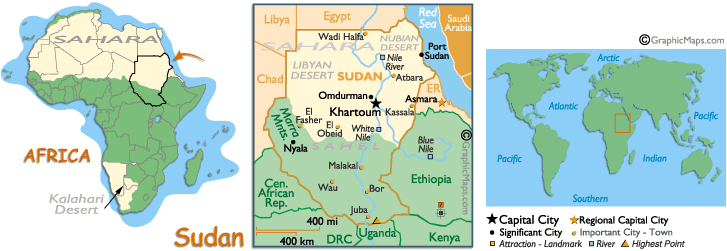
Area: 2.5 million sq. km. (967,500 sq. mi.); the largest country in Africa
and almost the size of continental U.S. east of the Mississippi River.
Cities: Capital--Khartoum (pop. 1.4 million). Other cities--Omdurman (2.1
million), Port Sudan (pop. 450,000), Kassala, Kosti, Juba (capital of
southern region).
Land boundaries: Central African Republic, Chad, Democratic Republic of
the Congo, Egypt, Eritrea, Ethiopia, Kenya, Libya, and Uganda.
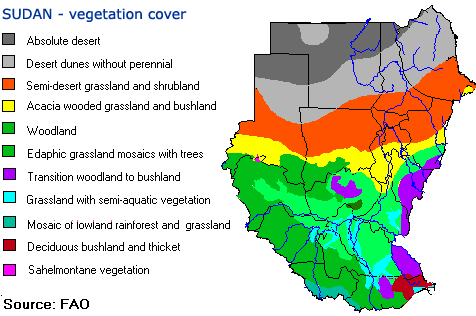
Terrain: Generally flat with mountains in east and west. Khartoum is
situated at the confluence of the Blue and White Nile Rivers. The southern
regions are inundated during the annual floods of the Nile River system
(the Suud or swamps).
Climate: Desert and savanna in the north and central regions and tropical
in the south.
People
Nationality: Noun and adjective (sing. and pl.)--Sudanese.
Population (July 2009 est.): 41,087,825; 43% urban.
Annual population growth rate (2009 est.): 2.143%.
Ethnic groups: Arab/Muslim north and black African/Christian and animist
south.
Religions: Islam (official), indigenous beliefs (southern Sudan),
Christianity.
Languages: Arabic (official), English (official), tribal languages.
Education: Years compulsory--8. Attendance--35%-40%. Literacy--61.1%.
Health: Infant mortality rate--82.43/1,000. Life expectancy--51.42 yrs.
Work force: Agriculture--80%; industry and commerce--7%; government--13%.
Government
Independence: January 1, 1956.
Type: Provisional Government established by the Comprehensive Peace
Agreement (CPA) signed in January 2005 that provides for power sharing
pending national elections. The national elections took place from April
11-15, 2010.
Constitution: The Interim National Constitution was adopted on July 6,
2005. It was drafted by the National Constitutional Review Commission, as
mandated by the January 2005 CPA. The Government of Southern Sudan also
has a constitution adopted in December 2005; it was certified by the
Ministry of Justice to be in conformity with the Interim National
Constitution and the Comprehensive Peace Agreement.
Branches: Executive--executive authority is held by the president, who
also is the prime minister, head of state, head of government, and
commander in chief of the armed forces; effective July 9, 2005, the
executive branch includes a first vice president and a vice president. As
stipulated by the Comprehensive Peace Agreement and Interim National
Constitution, the first vice president position is held by the president
of Southern Sudan, assuming the president is from the North.
Legislative--National Legislature. The National Assembly, the lower house,
has 450 elected members; an additional 46 seats will be appointed under a
political agreement between the two CPA parties to resolve disputes over
the accuracy of districting based on the May 2008 census. There is also an
upper house, the Council of States, which is composed of two
representatives from each of the nation's 25 states, and two observers
from the Abyei Area. Judicial--High Court, Minister of Justice, Attorney
General, civil and special tribunals.
Administrative subdivisions: Twenty-five states, most with an elected
governor, along with a state cabinet and elected state legislative
assembly.
Political parties: Currently there are many political parties in both the
nation's north and south. Seventy-two parties registered to take part in
the April 2010 elections. All political parties were banned following the
June 30, 1989 military coup. Political associations, taking the place of
parties, were authorized in 2000. Some parties are in self-imposed exile.
The principal national parties are the National Congress Party (NCP),
which attracts mainly northern support, and the Sudan People’s
Liberation Movement (SPLM), a southern Sudan-based party. These two
parties are signatories to the CPA.
Central government budget (2007 est.): $9.201 billion.
Defense (2005 est.): 3% of GDP.
Economy
GDP (2009 est.): $92.81 billion
GDP annual growth rate (2009 est.): 3.8%.
Per capita income GDP (2009 est.): $2,300.
Avg. annual inflation rate (2009 est.): 12.3%.
Natural resources: Modest reserves of oil, natural gas, gold, iron ore,
copper, and other industrial metals.
Agriculture: Products--cotton, peanuts, sorghum, sesame seeds, gum arabic,
sugarcane, millet, livestock.
Industry: Types--motor vehicle assembly, cement, cotton, edible oils and
sugar refining.
Trade: Exports (2009 est.)--$8.464 billion f.o.b.: crude oil and petroleum
products, cotton, gold, sorghum, peanuts, gum arabic, sugar, meat, hides,
live animals, and sesame seeds. Major markets China, Japan, Indonesia,
Egypt, United Arab Emirates, Saudi Arabia, Malaysia, South Korea. Imports
(2009 est.)--$6.823 billion f.o.b.: oil and petroleum products, oil
pipeline, pumping and refining equipment, chemical products and equipment,
wheat and wheat flour, transport equipment, foodstuffs, tea, agricultural
inputs and machinery, industrial inputs and manufactured goods. Major
suppliers--European Union, China, Malaysia, Saudi Arabia, Egypt, United
Arab Emirates, and India.
Fiscal year: January 1-December 31.
PEOPLE
Sudan’s population is one of the most diverse on the African continent.
Within two distinct major cultures--Arab and black African--there are
hundreds of ethnic and tribal subdivisions and language groups, which make
effective collaboration among them a major political challenge.
The northern states cover
most of the Sudan and include most of the urban centers. Most of the 30
million Sudanese who live in this region are Arabic-speaking Muslims,
though the majority also uses a non-Arabic mother tongue--e.g., Nubian,
Beja, Fur, Nuban, Ingessana, etc. Among these are several distinct tribal
groups: the Kababish of northern Kordofan, a camel-raising people; the Ja’alin
and Shaigiyya groups of settled tribes along the rivers; the semi-nomadic
Baggara of Kordofan and Darfur; the Hamitic Beja in the Red Sea area and
Nubians of the northern Nile areas, some of whom have been resettled on
the Atbara River; and the Nuba of southern Kordofan and Fur in the western
reaches of the country.
The southern region has a
population of around 8 million and a predominantly rural, subsistence
economy. Except for a 10-year hiatus, southern Sudan has been embroiled in
conflict, resulting in major destruction and displacement since
independence. The conflict has severely affected the population of the
South, resulting in over 2 million deaths and more than 4 million people
displaced between 1983 and 2005. The Southern Sudanese practice mainly
indigenous traditional beliefs, although Christian missionaries have
converted some. The South also contains many tribal groups and many more
languages than are used in the north. The Dinka--whose population is
estimated at more than 1 million--is the largest of the many black African
tribes in Sudan. The Shilluk and the Nuer are among the Nilotic tribes.
The Azande, Bor, and Jo Luo are Sudanic tribes in the west, and the Acholi
and Lotuhu live in the extreme south, extending into Uganda.
According to new census
results released in early 2009, Sudan’s population has reached an
estimated 41.1 million.
HISTORY
Sudan was a collection of small, independent kingdoms and principalities
from the beginning of the Christian era until 1820-21, when Egypt
conquered and unified the northern portion of the country. However,
neither the Egyptian nor the Mahdist state (1883-1898) had any effective
control of the southern region outside of a few garrisons. Southern Sudan
remained an area of fragmented tribes, subject to frequent attacks by
slave raiders.
In 1881, a religious leader
named Muhammad ibn Abdalla proclaimed himself the Mahdi, or the
"expected one," and began a religious crusade to unify the
tribes in western and central Sudan. His followers took on the name "Ansars"
(the followers) which they continue to use today and are associated with
the single largest political grouping, the Umma Party, led by a descendant
of the Mahdi, Sadiq al Mahdi.
Taking advantage of
dissatisfaction resulting from Ottoman-Egyptian exploitation and
maladministration, the Mahdi led a nationalist revolt culminating in the
fall of Khartoum in 1885. The Mahdi died shortly thereafter, but his state
survived until overwhelmed by an invading Anglo-Egyptian force under Lord
Kitchener in 1898. While nominally administered jointly by Egypt and
Britain, Britain exercised control, formulated policies, and supplied most
of the top administrators.
Independence
In February 1953, the United Kingdom and Egypt concluded an agreement
providing for Sudanese self-government and self-determination. The
transitional period toward independence began with the inauguration of the
first parliament in 1954. With the consent of the British and Egyptian
Governments, Sudan achieved independence on January 1, 1956, under a
provisional constitution. This constitution was silent on two crucial
issues for southern leaders--the secular or Islamic character of the state
and its federal or unitary structure. However, the Arab-led Khartoum
government reneged on promises to southerners to create a federal system,
which led to a mutiny by southern army officers that launched 17 years of
civil war (1955-72).
Sudan has been at war with
itself for more than three-quarters of its existence. Since independence,
protracted conflict rooted in deep cultural and religious differences have
slowed Sudan’s economic and political development and forced massive
internal displacement of its people. Northerners, who have traditionally
controlled the country, have sought to unify it along the lines of Arabism
and Islam despite the opposition of non-Muslims, southerners, and
marginalized peoples in the west and east. The resultant civil strife
affected Sudan’s neighbors, as they alternately sheltered fleeing
refugees or served as operating bases for rebel movements.
In 1958, General Ibrahim
Abboud seized power and pursued a policy of Arabization and Islamicization
for both North and South Sudan that strengthened Southern opposition.
General Abboud was overthrown in 1964 and a civilian caretaker government
assumed control. Southern leaders eventually divided into two factions,
those who advocated a federal solution and those who argued for
self-determination, a euphemism for secession since it was assumed the
south would vote for independence if given the choice.
Until 1969, there was a
succession of governments that proved unable either to agree on a
permanent constitution or to cope with problems of factionalism, economic
stagnation, and ethnic dissidence. These regimes were dominated by
"Arab" Muslims who asserted their Arab-Islamic agenda and
refused any kind of self-determination for southern Sudan.
In May 1969, a group of
communist and socialist officers led by Colonel Gaafar Muhammad Nimeiri,
seized power. A month after coming to power, Nimeiri proclaimed socialism
(instead of Islamism) for the country and outlined a policy of granting
autonomy to the South. Nimeiri in turn was the target of a coup attempt by
communist members of the government. It failed and Nimeiri ordered a
massive purge of communists. This alienated the Soviet Union, which
withdrew its support.
Already lacking support
from the Muslim parties he had chased from power, Nimeiri could no longer
count on the communist faction. Having alienated the right and the left,
Nimeiri turned to the south as a way of expanding his limited powerbase.
He pursued peace initiatives with Sudan’s hostile neighbors, Ethiopia
and Uganda, signing agreements that committed each signatory to withdraw
support for the other’s rebel movements. He then initiated negotiations
with the southern rebels and signed an agreement in Addis Ababa in 1972
that granted a measure of autonomy to the South. Southern support helped
him put down two coup attempts, one initiated by officers from the western
regions of Darfur and Kordofan who wanted for their region the same
privileges granted to the south.
However, the Addis Ababa
Agreement had no support from either the secularist or Islamic Northern
parties. Nimeiri concluded that their lack of support was more threatening
to his regime than lack of support from the south so he announced a policy
of national reconciliation with all the religious opposition forces. These
parties did not feel bound to observe an agreement they perceived as an
obstacle to furthering an Islamist state. The scales against the peace
agreement were tipped in 1979 when Chevron discovered oil in the south.
Northern pressure built to abrogate those provisions of the peace treaty
granting financial autonomy to the south. Ultimately in 1983, Nimeiri
abolished the Southern region, declared Arabic the official language of
the South (instead of English) and transferred control of Southern armed
forces to the central government. This was effectively a unilateral
abrogation of the 1972 peace treaty. The second Sudan civil war began in
January 1983 when southern soldiers mutinied rather than follow orders
transferring them to the North.
In September 1983, as part
of an Islamicization campaign, President Nimeiri announced that
traditional Islamic punishments drawn from Shari’a (Islamic Law) would
be incorporated into the penal code. This was controversial even among
Muslim groups. Amputations for theft and public lashings for alcohol
possession became common. Southerners and other non-Muslims living in the
north were also subjected to these punishments.
In April 1985, while out of
the country, Nimeiri was overthrown by a popular uprising in Khartoum
provoked by a collapsing economy, the war in the south, and political
repression. Gen. Suwar al-Dahab headed the transitional government. One of
its first acts was to suspend the 1983 constitution and disband Nimeiri’s
Sudan Socialist Union.
Elections were held in
April 1986, and a civilian government took over power. There were
tentative moves towards negotiating peace with the south. However, any
proposal to exempt the south from Islamic law was unacceptable to those
who supported Arabic supremacy. In 1989, an Islamic army faction led by
General Umar al-Bashir mounted a coup and installed the National Islamic
Front. The new government’s commitment to the Islamic cause intensified
the North-South conflict.
The Bashir government
combined internal political repression with international Islamist
activism. It supported radical Islamist groups in Algeria and supported
Iraq’s invasion of Kuwait. Khartoum was established as a base for
militant Islamist groups: radical movements and terrorist organizations
like Osama Bin Laden’s al Qaida were provided a safe haven and
logistical aid in return for financial support. In 1996, the UN imposed
sanctions on Sudan for alleged connections to the assassination attempt on
Egyptian President Mubarak.
Meanwhile, the period of
the 1990s saw a growing sense of alienation in the western and eastern
regions of Sudan from the Arab center. The rulers in Khartoum were seen as
less and less responsive to the concerns and grievances of both Muslim and
non-Muslim populations across the country. Alienation from the
"Arab" center caused various groups to grow sympathetic to the
southern rebels led by the Sudan People’s Liberation Movement/Army (SPLM/A),
and in some cases, prompted them to flight alongside it.
The policy of the ruling
regime toward the South was to pursue the war against the rebels while
trying to manipulate them by highlighting tribal divisions. Ultimately,
this policy resulted in the rebels’ uniting under the leadership of
Colonel John Garang. During this period, the SPLM/A rebels also enjoyed
support from Ethiopia, Eritrea, and Uganda. The Bashir government's
"Pan-Islamic" foreign policy, which provided support for
neighboring radical Islamist groups, was partly responsible for this
support for the rebels.
The 1990s saw a succession
of regional efforts to broker an end to the Sudanese civil war. Beginning
in 1993, the leaders of Eritrea, Ethiopia, Uganda, and Kenya pursued a
peace initiative for the Sudan under the auspices of the Intergovernmental
Authority for Development (IGAD), but results were mixed. Despite that
record, the IGAD initiative promulgated the 1994 Declaration of Principles
(DOP) that aimed to identify the essential elements necessary to a just
and comprehensive peace settlement; i.e., the relationship between
religion and the state, power sharing, wealth sharing, and the right of
self-determination for the south. The Sudanese Government did not sign the
DOP until 1997 after major battlefield losses to the SPLA. That year, the
Khartoum government signed a series of agreements with rebel factions
under the banner of "Peace from Within." These included the
Khartoum, Nuba Mountains, and Fashoda Agreements that ended military
conflict between the government and significant rebel factions. Many of
those leaders then moved to Khartoum where they assumed marginal roles in
the central government or collaborated with the government in military
engagements against the SPLA. These three agreements paralleled the terms
and conditions of the IGAD agreement, calling for a degree of autonomy for
the south and the right of self-determination.
End to the Civil War
In July 2002, the Government of Sudan and the SPLM/A reached an historic
agreement on the role of state and religion and the right of southern
Sudan to self-determination. This agreement, known as the Machakos
Protocol and named after the town in Kenya where the peace talks were
held, concluded the first round of talks sponsored by the IGAD. The effort
was mediated by retired Kenyan General Lazaro Sumbeiywo. Peace talks
resumed and continued during 2003, with discussions focusing on wealth
sharing and three contested areas.
On November 19, 2004, the
Government of Sudan and the SPLM/A signed a declaration committing
themselves to conclude a final comprehensive peace agreement by December
31, 2004, in the context of an extraordinary session of the United Nations
Security Council (UNSC) in Nairobi, Kenya--only the fifth time the Council
has met outside of New York since its founding. At this session, the UNSC
unanimously adopted Resolution 1574, which welcomed the commitment of the
government and the SPLM/A to achieve agreement by the end of 2004, and
underscored the international community’s intention to assist the
Sudanese people and support implementation of the comprehensive peace
agreement. In keeping with their commitment to the UNSC, the Government of
Sudan and the SPLM/A initialed the final elements of the comprehensive
agreement on December 31, 2004. The two parties formally signed the
Comprehensive Peace Agreement (CPA) on January 9, 2005. The U.S. and the
international community welcomed this decisive step forward for peace in
Sudan.
GOVERNMENT AND POLITICAL
CONDITIONS
Comprehensive Peace
Agreement
The 2005 CPA established a new Government of National Unity and the
interim Government of Southern Sudan and called for wealth-sharing,
power-sharing, and security arrangements between the two parties. The
historic agreement provides for a ceasefire, withdrawal of troops from
southern Sudan, and the repatriation and resettlement of refugees. It also
stipulated that by the end of the fourth year of an interim period there
would be elections at all levels, including for national and southern
Sudan president, state governors, and national, southern Sudan, and state
legislatures. These elections were held in April 2010.
On July 9, 2005, the
Presidency was inaugurated with al-Bashir sworn in as President and John
Garang, SPLM/A leader, installed as First Vice President of Sudan.
Ratification of the Interim National Constitution followed. The
Constitution declares Sudan to be a “democratic, decentralized,
multi-cultural, multi-ethnic, multi-religious, and multi-lingual State.”
On July 30, 2005, the
charismatic and revered SPLM leader John Garang died in a helicopter
crash. The SPLM/A immediately named Salva Kiir, Garang’s deputy, as
First Vice President of the Government of National Unity and President of
the Government of Southern Sudan.
Implemented provisions of
the CPA include the formation of the National Legislature, appointment of
Cabinet members, establishment of the Government of Southern Sudan and the
signing of the interim Southern Sudan Constitution, and the appointment of
state governors and adoption of state constitutions. The electoral law
paving the way for national elections was passed in July 2008, and
elections were held at six levels in April 2010. Laws governing the
Southern Sudan and Abyei referenda and the popular consultations in
Southern Kordofan and Blue Nile were passed in December 2009, and the
parties agreed in February 2010 to begin demarcation of the north-south
border.
New CPA-mandated
commissions have also been created. Thus far, those formed include the
National Electoral Commission, Assessment and Evaluation Commission,
National Petroleum Commission, Fiscal and Financial Allocation and
Monitoring Commission, and the North-South Border Commission. The
Ceasefire Political Commission, Joint Defense Board, and Ceasefire Joint
Military Committee were also established as part of the security
arrangements of the CPA.
With the establishment of
the National Population Census Council, a population census was conducted
in April/May 2008 in preparation for national elections that took place
from April 11-15, 2010. The results from the census were released in early
2009. The CPA mandates that a referendum be held no later than January
2011, giving southerners the opportunity to vote either for unity within
Sudan or separation, and that a parallel referendum be held for the people
of Abyei to determine whether they wish to remain in the North or join the
South.
Progress has been achieved
during the last 5 years, though implementation of some CPA requirements
has been slow, and there are still major issues that need to be addressed.
The issue of the boundaries of Abyei was finally resolved through
arbitration in The Hague concluding in July 2009, and both sides have
accepted the arbitration decision. The Abyei boundary has not been
demarcated, however. In August 2009, in conjunction with discussions
facilitated by the United States, the two CPA parties signed an agreement
charting a path forward on 10 points critical to implementation of the
CPA. The parties continue to work through issues related to CPA
implementation.
National elections took
place from April 11-15, 2010. The elections were largely peaceful.
However, there were widespread irregularities reported during the polling
and counting periods, as well as serious restrictions on political space
in both north and south leading up to and during the elections. The NCP
and SPLM won the overwhelming majority of the electoral races, and
incumbent presidents were elected for the Government of Sudan and the
autonomous Government of Southern Sudan.
Darfur
In 2003, while the historic north-south conflict was on its way to
resolution, increasing reports began to surface of attacks on civilians,
especially aimed at non-Arab tribes in the extremely marginalized Darfur
region of Sudan. A rebellion broke out in Darfur, led by two rebel
groups--the Sudan Liberation Movement/Army (SLM/A) and the Justice and
Equality Movement (JEM). These groups represented agrarian farmers who are
mostly non-Arabized black African Muslims. In seeking to defeat the rebel
movements, the Government of Sudan increased arms and support to local,
rival tribes and militias, which have come to be known as the "Janjaweed."
Their members were composed mostly of Arabized black African Muslims who
herded cattle, camels, and other livestock. Attacks on the civilian
population by the Janjaweed, often with the direct support of Government
of Sudan Armed Forces (SAF), have led to the death of hundreds of
thousands of people in Darfur, with an estimated 2 million internally
displaced people and another 250,000 refugees in neighboring Chad.
On September 9, 2004,
Secretary of State Colin L. Powell told the Senate Foreign Relations
Committee, "genocide has been committed in Darfur and that the
Government of Sudan and the Janjaweed bear responsibility--and that
genocide may still be occurring." President George W. Bush echoed
this in July 2005, when he stated that the situation in Darfur was
"clearly genocide."
Intense international
efforts to solve the crisis got underway, and a cease-fire between the
parties was signed in N’Djamena, Chad, on April 8, 2004. However,
despite the deployment of an African Union (AU) military mission to
monitor implementation of the cease-fire and investigate violations,
violence continued. The SLM/A and JEM negotiated with the Government of
Sudan under African Union auspices, resulting in an agreement being signed
regarding additional protocols addressing the humanitarian and security
aspects of the conflict on November 9, 2004. Like previous agreements,
however, these were violated by both sides. Talks resumed in Abuja on June
10, 2005, resulting in a July 6 signing of a Declaration of Principles.
Further talks were held in the fall and early winter of 2005 and covered
power sharing, wealth sharing, and security arrangements. These
negotiations were complicated by a split that occurred in SLM/A
leadership. The SLM/A now had a faction loyal to Minni Minawi and a
faction loyal to Abdel Wahid.
The African Union, with the
support of the United Nations Security Council (UNSC), the U.S., and the
rest of the international community, began deploying a larger monitoring
and observer force in October 2004. The UNSC had passed three resolutions
(1556, 1564, and 1574), all intended to compel the Government of Sudan to
rein in the Janjaweed, protect the civilian population and humanitarian
participants, seek avenues toward a political settlement to the
humanitarian and political crisis, and recognize the need for the rapid
deployment of an expanded African Union mission in Darfur. The U.S. has
been a leader in pressing for strong international action by the United
Nations and its agencies.
A series of UNSC
resolutions in late March 2005 underscored the concerns of the
international community regarding Sudan's continuing conflicts. Resolution
1590 established the UN Mission in Sudan (UNMIS) for an initial period of
6 months and decided that UNMIS would consist of up to 10,000 military
personnel and up to 715 civilian police personnel. It requested UNMIS to
coordinate with the African Union Mission in Sudan (AMIS) to foster peace
in Darfur, support implementation of the CPA, facilitate the voluntary
return of refugees and internally displaced persons, provide humanitarian
demining assistance, and protect human rights. The resolution also called
on the Government of Sudan and rebel groups to resume the Abuja talks and
support a peaceful settlement to the conflict in Darfur, including
ensuring safe access for peacekeeping and humanitarian operations.
Resolution 1591 criticized
the Government of Sudan and rebels in Darfur for having failed to comply
with several previous UNSC resolutions, for ceasefire violations, and for
human rights abuses. The resolution also called on all parties to resume
the Abuja talks and to support a peaceful settlement to the conflict in
Darfur; it also forms a monitoring committee charged with enforcing a
travel ban and asset freeze of those determined to impede the peace
process or violate human rights. Additionally, the resolution demanded
that the Government of Sudan cease conducting offensive military flights
in and over the Darfur region. Finally, Resolution 1593 referred the
situation in Darfur to the prosecutor of the International Criminal Court
(ICC) and called on the Government of Sudan and all other parties to the
conflict in Darfur to cooperate with the ICC.
Following the UNSC
resolutions and intense international pressure, the Darfur rebel groups
and the Government of Sudan resumed negotiations in Abuja, Nigeria in
early 2006. On May 5, 2006, the government and an SLM/A faction led by
Minni Minawi signed the Darfur Peace Agreement (DPA). Unfortunately, the
conflict in Darfur intensified shortly thereafter, led by rebel groups who
refused to sign. In late August government forces began a major offensive
on rebel areas in Northern Darfur. On August 30, the Security Council
adopted UNSCR 1706, authorizing the transition of AMIS to a larger more
robust UN peacekeeping operation. To further facilitate an end to the
conflict in Darfur, President Bush announced the appointment of Andrew S.
Natsios as the Special Envoy for Sudan on September 19, 2006.
In an effort to resolve
Sudan’s opposition to a UN force, UN Secretary General Kofi Annan and
African Union Commission Chair Alpha Oumar Konare convened a meeting of
key international officials and representatives of several African and
Arab states in Addis Ababa on November 16, 2006. The agreement reached
with the Government of Sudan provided for graduated UN support to AMIS
culminating in the establishment of a joint “hybrid” AU-UN
peacekeeping operation in Darfur.
International efforts in
2007 focused on rallying support for DPA signatory and non-signatory rebel
movements to attend renewed peace talks, and on finalizing plans for the
joint AU/UN hybrid operation. UN Security Council Resolution 1769 was
adopted on July 31, 2007, providing the mandate for a joint AU/UN hybrid
force to deploy to Darfur with troop contributions from African countries.
The Joint AU-UN Mission in Darfur (UNAMID) was to assume authority from
AMIS in the field no later than December 31, 2007.
Following the passage of
UNSCR 1769, a conference was held August 3-5 in Arusha, Tanzania between
key UN and AU officials and delegates from Darfur rebel groups. Many
movements’ political and military leaderships were brought into the
discussion in preparation for earnest peace talks. Peace talks between the
Government of Sudan and rebel factions took place in Sirte, Libya on
October 27, 2007. However, limited rebel participation and continuing
disagreement about objectives and processes limited the effectiveness of
these talks. Following the Sirte talks, the SPLM hosted workshops in Juba,
Southern Sudan, to unite the rebel groups and allow them to come together
to present a common front during negotiations. The Juba talks led to a
consolidation of rebel factions down to five groups from an estimated 27.
On December 21, 2007 President Bush announced the appointment of
Ambassador Richard S. Williamson as Special Envoy for Sudan, following the
resignation of Andrew S. Natsios.
On July 14, 2008 the Chief
Prosecutor of the International Criminal Court (ICC), Luis Moreno-Ocampo,
announced that he was seeking an arrest warrant for President Bashir for
allegedly masterminding genocide, war crimes, and crimes against humanity
in Darfur. In order to move quickly to find a solution to the violence in
Darfur under the pressure of a possible ICC indictment, Sudan opened the
Sudan People’s Initiative in October 2008. The conference brought
together many Darfur rebel groups with the government for a conference to
explore solutions and how to better implement the existing framework of
the DPA. It culminated in the announcement of a unilateral Darfur
ceasefire, which was reportedly violated within days of the declaration.
On March 4, 2009 the ICC
announced that it was issuing an arrest warrant for President Bashir for
crimes against humanity and war crimes. The three-judge panel that issued
the warrant did not feel there was enough evidence to include the crime of
genocide on the warrant. In response to the ICC indictment, the Government
of Sudan expelled 13 international non-government organizations (NGOs) and
closed down three Sudanese NGOs, which severely hindered international
humanitarian aid efforts in Darfur. Despite the warrant for his arrest,
Bashir has traveled freely to a number of countries in Africa and the
Middle East since his indictment.
In early 2009, the Joint
African Union-United Nations Chief Mediator Djibril Bassole convened talks
in Doha, Qatar, between the Government of Sudan and several Darfuri rebel
groups, most notably JEM. Although JEM and the government signed a
goodwill agreement in February 2009, talks collapsed in May over prisoner
swaps and humanitarian access. Throughout the summer of 2009, the AU-UN
mediation team worked individually with the parties and civil society to
prepare for a new round of negotiations, while President Barack Obama’s
Special Envoy to Sudan, Major General (Ret.) J. Scott Gration, supported
these efforts by working to unify a number of splintered rebel factions in
preparation for negotiations, and pressing the government to commit to a
new round of talks. In November 2009, the mediation team organized a
series of meetings in Doha between the parties and Darfuri civil society
in an effort to better represent the voices of the Darfuri people in the
peace process.
On January 15, 2010, Sudan
and Chad signed an accord in N’Djamena, Chad, to secure their joint
border and remove the threat posed to one another by cross-border rebel
proxies operating on Sudanese and Chadian territory. The U.S. supported
the signing of this agreement, which, if fully implemented, could help to
improve the security situation on the ground in Darfur. On April 13, 2010,
the parties announced that elements of the joint border force had been
deployed and the border had been officially opened for commerce and
transit.
On February 3, 2010, the
ICC Appeals Court decided that the original three-judge panel used too
high an evidentiary standard to omit genocide from the March 4, 2009,
indictment of Bashir, and instructed the panel to revisit its decision.
On February 23, 2010, the
Government of Sudan and JEM signed a 12-point framework agreement in Doha,
in which the parties agreed to a ceasefire, a prisoner release, and the
opening of a new round of formal negotiations. In the wake of this initial
progress with JEM, several other armed movements, including SLA factions
unified by the efforts of the U.S. and Libya, joined together in Doha
under the umbrella of the Liberation and Justice Movement (LJM). On March
18, 2010, the Government of Sudan and the LJM signed a framework agreement
and a ceasefire. Although negotiations in Doha were suspended during the
April 11-15 national elections, talks between the Government of Sudan and
the LJM resumed in June 2010. On May 3, JEM announced that it was “freezing”
its participation in the Doha talks due to the Government of Sudan’s
offensive against JEM positions in Jebel Moon, West Darfur. Since that
time, the talks between the Government of Sudan and the LJM have
continued. The African Union/United Nations Joint Chief Mediator announced
at the beginning of September, along with the host Government of Qatar, a
timeline that would produce a final outcome document from these
negotiations. The AU/UN mediation team and international community
continue to press the JEM and Abdul Wahid’s faction of the SLA to join
negotiations without preconditions.
Humanitarian Situation
Sudan continues to cope with the countrywide effects of conflict,
displacement, and insecurity. During more than 20 years of conflict
between the Government of Sudan and the Sudan People's Liberation
Movement/Army (SPLM/A), violence, famine, and disease killed more than 2
million people, forced an estimated 600,000 people to seek refuge in
neighboring countries, and displaced approximately 4 million others within
Sudan, creating the world's largest population of internally displaced
people. Since the 2005 signing of the Comprehensive Peace Agreement (CPA),
which officially ended the North-South conflict, the UN estimates that
nearly 2 million displaced people have returned to Southern Sudan and the
Three Areas of Southern Kordofan, Blue Nile, and Abyei. As of September
2009, the UN estimated that Lord’s Resistance Army (LRA)-related
violence had displaced approximately 85,000 people in Southern Sudan,
including more than 18,000 refugees from the Democratic Republic of the
Congo and the Central African Republic. In addition, inter-ethnic conflict
in Jonglei, Upper Nile, and Lakes states has killed more than 2,000 people
and displaced approximately 250,000 individuals since January 2009.
In March 2009, following
the ICC’s issuance of the arrest warrant for Bashir, the Government of
Sudan expelled 13 international humanitarian aid organizations from Sudan
and shut down three national aid organizations in a decision it publicly
claimed was “long-overdue.” These organizations served as U.S.
Government and UN implementing partners for the provision of, among other
services, water and sanitation, health care, and protection, and their
forced departure, according to the UN, affects 50% of aid delivery in
Sudan. In the absence of expelled non-governmental organizations (NGOs),
UN agencies and remaining NGOs stepped in to fill some of the critical
gaps and address immediate humanitarian needs. The UN, the United States,
and other members of the international community have since urged the
Government of Sudan to reverse its decision on the expulsions, to identify
and respond to gaps in life-saving operations, and to facilitate an
orderly transition to working through the remaining NGOs. On March 18,
2009 President Obama announced the appointment of Major General (Ret.) J.
Scott Gration as the U.S. Special Envoy to Sudan. Special Envoy Gration
negotiated with the Government of Sudan to allow the entry of four new
NGOs to help address the humanitarian gaps. The Government of Sudan has
been somewhat cooperative regarding the loosening of some administrative
and bureaucratic impediments that have hindered the fast and effective
delivery of humanitarian assistance in the past.
The conflict in the western
region of Darfur entered its seventh year in 2010, despite a 2006 peace
agreement--the Darfur Peace Agreement (DPA)--between the Government of
National Unity and one faction of the Sudan Liberation Army, that of Minni
Minawi. It remains to be seen whether the ongoing Doha peace process will
be able to effectively help quell the fighting in Darfur among armed
opposition group factions, the Sudanese Armed Forces, and militias, which
continued to displace thousands of civilians into 2010--230,000 since
January 2008 alone. The complex emergency in Darfur affects approximately
4.2 million people, including more than 2.7 million internally displaced
people, approximately 250,000 refugees in Chad, and approximately 50,000
refugees in the Central African Republic.
The U.S. Government is the
leading international donor to Sudan and has contributed more than $8
billion in humanitarian, development, peacekeeping, and reconstruction
assistance for the people in Sudan and eastern Chad since 2005, including
more than $2 billion in FY 2009 alone. The U.S. Mission in Sudan has
declared disasters due to the complex emergency on an annual basis since
1987. On October 1, 2009, President Obama renewed the Sudan complex
emergency disaster declaration for FY 2010. The U.S. Government continues
to lead the international effort to support implementation of the CPA,
while providing for the humanitarian needs of conflict-affected
populations throughout the country. U.S. Government humanitarian
assistance to Sudan includes food aid, provision of health care, water,
sanitation, and hygiene, as well as programs for nutrition, agriculture,
protection, and economic recovery.
Principal Government
Officials
President, Prime Minister, and Commander in Chief of the Armed Forces--Lt.
Gen. Omar Hassan Ahmed al-Bashir
First Vice President--Salva Kiir Mayardit
Vice President--Ali Osman Muhamad Taha
Foreign Minister--Ahmed Ali Karti
Ambassador to the U.S.--Sudan is represented by Charge d'Affaires Akec
Khoc Aciew Khoc
Ambassador to the UN--Abdalmahmood Abdalhaleem Mohamed
Sudan maintains an embassy
in the United States at 2210 Massachusetts Ave. NW, Washington, DC 20008 (tel:
(202) 338-8565; fax: (202) 667-2406); and a Consular Office at 2612
Woodley Place, NW, Washington, DC 20008 (tel: (202) 232-1492; fax: (202)
232-1494).
The regional Government of
Southern Sudan maintains a liaison office in the United States at 1233
20th St. NW, Suite 602, Washington, DC 20036 (tel: (202) 293-7940; fax:
(202) 293-7941).
ECONOMY
In 2004, the cessation of major north-south hostilities and expanding
crude oil exports resulted in 6.4% GDP growth and a near doubling of GDP
per capita since 2003. The aftereffects of the 21-year civil war and very
limited infrastructure, however, present obstacles to stronger growth and
a broader distribution of income. The country continued taking some steps
toward transitioning from a socialist to a market-based economy, although
the government and governing party supporters remained heavily involved in
the economy.
Sudan’s primary resources
are agricultural, but oil production and export have taken on greater
importance since October 2000. Although the country is trying to diversify
its cash crops, cotton, and gum arabic remain its major agricultural
exports. Grain sorghum (dura) is the principal food crop, and millet and
wheat are grown for domestic consumption. Sesame seeds and peanuts are
cultivated for domestic consumption and increasingly for export. Livestock
production has vast potential, and many animals, particularly camels and
sheep, are exported to Egypt, Saudi Arabia, and other Arab countries.
However, Sudan remains a net importer of food. Problems of irrigation and
transportation remain the greatest constraints to a more dynamic
agricultural economy.
The country’s
transportation facilities consist of 5,978 kilometers of railways, 16
airports with paved runways, and about 11,900 kilometers of paved and
gravel road--primarily in greater Khartoum, Port Sudan, and the north.
Some north-south roads that serve the oil fields of central/south Sudan
have been built; and a 1,400 kilometer. (840 miles) oil pipeline goes from
the oil fields via the Nuba Mountains and Khartoum to the oil export
terminal in Port Sudan on the Red Sea.
Sudan’s limited
industrial development consists of agricultural processing and various
light industries located in Khartoum North. In recent years, the GIAD
industrial complex introduced the assembly of small autos and trucks, and
some heavy military equipment such as armored personnel carriers and the
proposed "Bashir" main battle tank. Although Sudan is reputed to
have great mineral resources, exploration has been quite limited, and the
country’s real potential is unknown. Small quantities of asbestos,
chromium, and mica are exploited commercially.
Extensive petroleum
exploration began in the mid-1970s and might cover all of Sudan’s
economic and energy needs. Significant finds were made in the Upper Nile
region and commercial quantities of oil began to be exported in October
2000, reducing Sudan’s outflow of foreign exchange for imported
petroleum products. There are indications of significant potential
reserves of oil and natural gas in southern Sudan, the Kordofan region and
the Red Sea province.
Historically, the U.S., the
Netherlands, Italy, Germany, Saudi Arabia, Kuwait, and other Organization
of Petroleum Exporting Countries (OPEC) have supplied most of Sudan’s
economic assistance. Sudan’s role as an economic link between Arab and
African countries is reflected by the presence in Khartoum of the Arab
Bank for African Development. The World Bank had been the largest source
of development loans.
Sudan will require
extraordinary levels of program assistance and debt relief to manage a
foreign debt exceeding $21 billion, more than the country’s entire
annual gross domestic product. During the late 1970s and 1980s, the
International Monetary Fund (IMF), World Bank, and key donors worked
closely to promote reforms to counter the effect of inefficient economic
policies and practices. By 1984, a combination of factors--including
drought, inflation, and confused application of Islamic law--reduced donor
disbursements, and capital flight led to a serious foreign-exchange crisis
and increased shortages of imported inputs and commodities. More
significantly, the 1989 revolution caused many donors in Europe, the U.S.,
and Canada to suspend official development assistance, but not
humanitarian aid.
However, as Sudan became
the world’s largest debtor to the World Bank and IMF by 1993, its
relationship with the international financial institutions soured in the
mid-1990s and has yet to be fully rehabilitated. The government fell out
of compliance with an IMF standby program and accumulated substantial
arrearages on repurchase obligations. A 4-year economic reform plan was
announced in 1988 but was not pursued. An economic reform plan was
announced in 1989 and implementation began on a 3-year economic
restructuring program designed to reduce the public sector deficit, end
subsidies, privatize state enterprises, and encourage new foreign and
domestic investment. In 1993, the IMF suspended Sudan’s voting rights
and the World Bank suspended Sudan’s right to make withdrawals under
effective and fully disbursed loans and credits. Lome Funds and European
Union agricultural credits, totaling more than 1 billion euros, also were
suspended.
Sudan produces about
401,000 barrels per day (b/d) (2005 est.) of oil, which brought in about
$1.9 billion in 2005 and provides 70% of the country’s total export
earnings. Although final figures are not yet available, these earnings may
have risen to an estimated $2 billion as of the end of 2004. Oil
production in Sudan as of 2007 was at 466,100 barrels of oil a day. With a
resolution of its 21-year civil war between the North and South, Sudan and
its people can now begin to reap the benefit from its natural resources,
rebuild its infrastructure, increase oil production and exports, and be
able to attain its export and development potential.
In 2000-2001, Sudan’s
current account entered surplus for the first time since independence. In
1993, currency controls were imposed, making it illegal to possess foreign
exchange without approval. In 1999, liberalization of foreign exchange
markets ameliorated this constraint somewhat. Exports other than oil are
largely stagnant. The small industrial sector remains in the doldrums, and
Sudan’s inadequate and declining infrastructure inhibits economic
growth.
DEFENSE
The Sudan People’s Armed Forces is a 100,000-member army supported by a
small air force and navy. Irregular tribal and former rebel militias and
Popular Defense Forces supplement the army’s strength in the field. This
is a mixed force, having the additional duty of maintaining internal
security. During the 1990s, periodic purges of the professional officer
corps by the ruling Islamist regime eroded command authority as well as
war-fighting capabilities. Indeed, the Sudanese Government admitted it was
incapable of carrying out its war aims against the SPLA without employing
former rebel and Arab militias to fight in support of regular troops.
Additionally, as mandated in the CPA, the Southern Sudanese maintain their
own armed forces in the form of the SPLA.
Sudan’s military forces
historically have been hampered by limited and outdated equipment. In the
1980s, the U.S. worked with the Sudanese Government to upgrade equipment
with special emphasis on airlift capacity and logistics. All U.S. military
assistance was terminated following the military coup of 1989. Oil
revenues have allowed the government to purchase modern weapons systems,
including Hind helicopter gunships, Antonov medium bombers, MiG 23 fighter
aircraft, mobile artillery pieces, and light assault weapons. Sudan now
receives most of its military equipment from China, Russia, and Libya.
The Sudan People’s
Liberation Army (SPLA) in southern Sudan is currently in the process of
transformation from a guerrilla force to a professional military
organization.
FOREIGN RELATIONS
Solidarity with other Arab countries has been a feature of Sudan’s
foreign policy. When the Arab-Israeli war began in June 1967, Sudan
declared war on Israel. However, in the early 1970s, Sudan gradually
shifted its stance and was supportive of the Camp David Accords.
Relations between Sudan and
Libya deteriorated in the early 1970s and reached a low in October 1981,
when Libya began a policy of cross-border raids into western Sudan. After
the 1985 coup in Sudan, the military government resumed diplomatic
relations with Libya, as part of a policy of improving relations with
neighboring and Arab states. In early 1990, Libya and the Sudan announced
that they would seek "unity," but this unity was not
implemented.
During the 1990s, as Sudan
sought to steer a nonaligned course, courting Western aid and seeking
rapprochement with Arab states, its relations with the U.S. grew
increasingly strained. Sudan’s ties with countries like North Korea and
Libya and its support for regional insurgencies such as Egyptian Islamic
Jihad, Eritrean Islamic Jihad, Ethiopian Islamic Jihad, Palestinian
Islamic Jihad, Hamas, Hezbollah, and the Lord’s Resistance Army
generated great concern about its contribution to regional instability.
Allegations of the government’s complicity in the assassination attempt
against the Egyptian President in Ethiopia in 1995 led to UNSC sanctions
against the Sudan. By the late 1990s, Sudan experienced strained or broken
diplomatic relations with most of its nine neighboring countries. However,
since 2000, Sudan has actively sought regional rapprochement that has
rehabilitated most of these relations.
sources: CIA World
Fact Book, United Nations, U.S. Department of State,The BBC,The Washington Post
Data
compiled from The British Antarctic Study, NASA, Environment Canada,
UNEP, EPA and other sources as stated and credited Researched by Charles
Welch-Updated daily This Website is a project of the The Ozone Hole Inc.
a 501(c)(3) Nonprofit Organization http://www.theozonehole.com